
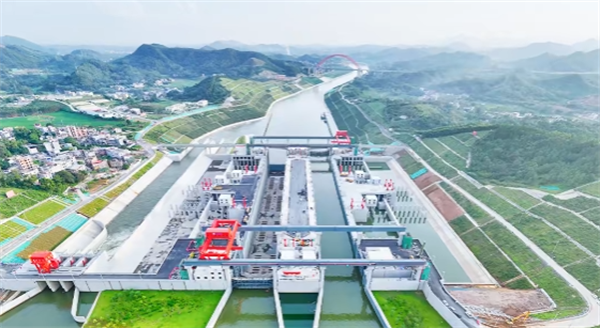
Newest · Strongest · Largest! Pinglu Canal Officially Opens to Navigation Today; Southwest Sand and Gravel Aggregates Redraw the Sea-Outlet Map
The Xijiang River Basin’s 100-million-tonne-class production capacity has long been constrained by a single channel—“eastward down the Xijiang River and transshipment around the Pearl River Delta.” With the canal open, there is now another sea outlet directly linking to the deep sea. The pricing logic and flow map of sand and gravel supply and demand in the Pan-Pearl River Delta will consequently be reshuffled.
On the morning of September 16, 2026, the Pinglu Canal, a backbone project of the New International Land-Sea Trade Corridor, officially opened to navigation. The 134.2-kilometer waterway starts at Pingtang River Mouth in the Xijin Reservoir Area of Hengzhou City, Nanning, in the north, passes through Luwu Town, Lingshan County, and follows the Qinjiang River to the Beibu Gulf. It is the first river-to-sea canal coordinated and built at the national level since the founding of New China, with a total investment of about RMB 72.7 billion.
For the sand and gravel industry, once the Pinglu Canal is fully connected, the southeastern coast and the inland hinterland will be brought into the same river-sea intermodal closed loop—limestone aggregates along the Xijiang River can be directly unloaded at Beibu Gulf Port and shipped out, shortening the inland river voyage by more than 560 kilometers compared with detouring via Guangzhou Port. The transport distance and cost structure between southwestern mineral sources and demand sides in the Pearl River Delta, Hainan, and ASEAN will be restructured simultaneously. The Xijiang River Basin’s 100-million-tonne-class production capacity has long been constrained by a single channel—“eastward down the Xijiang River and transshipment around the Pearl River Delta.” With the canal open, there is now another sea outlet directly linking to the deep sea, and the pricing logic and flow map of sand and gravel supply and demand in the Pan-Pearl River Delta will be reshuffled accordingly.
Where do the three “mosts” come from?
It is reported that this century project has gathered multiple hardcore labels such as newest, strongest, and largest. Behind these “mosts” is the true hard power of the Pinglu Canal.
Newest—from Pingtang River Mouth to the Beibu Gulf, a brand-new water artery has been opened. Previously, newly built canals in China mostly served the function of connecting rivers. The Pinglu Canal is the first national-level river-to-sea canal directly connecting the main stem of the Xijiang River with the Beibu Gulf, pioneering the dual attributes of a modern canal: inland river plus ocean-going.
Strongest—built to Class I inland waterway standards, it allows 5,000-tonne-class vessels to sail smoothly and has the strongest navigation capacity among similar canals in the world. Cargo from Southwest China going to sea via this route travels more than 560 kilometers less inland waterway distance than traditional routes, reducing comprehensive logistics costs by 18%–30% and saving society more than RMB 5 billion in transport costs annually.
Largest—the total earthwork excavation volume reached 315 million cubic meters, nearly three times that of the Three Gorges Hub, making it the transportation project with the largest earthwork volume in China. The Madao Hub also set two world records: its water-saving ship lock has an upstream-downstream water level difference of 29.6 meters and a lock chamber of 300 meters × 34 meters, the largest water-saving ship lock on an inland waterway in the world.
This river redraws the Pan-Pearl River Delta sand and gravel map
In the past, southwestern aggregates traveled east down the Xijiang River to the Pearl River Delta, a detour of about 694 kilometers; after the Pinglu Canal opened, the inland river sea-outlet voyage is shortened by more than 560 kilometers. Ten-million-tonne-class granite aggregates around Nanning can be shipped directly to the Beibu Gulf, reaching Hainan and ASEAN, and the pricing logic between Guangxi’s newly added capacity and Guangdong’s construction sand is being recut.
Coinciding with the third day after the canal opens—September 19, 2026—the “2026 Pan-Pearl River Delta Sand and Gravel Market Summit and Autumn Ordering Fair” will be held at Crowne Plaza Foshan Nanhai Liti (No. 20 Huandao South Road, Nanhai District, Foshan, Guangdong). With the theme “Breaking the Deadlock and Restructuring · Value Breakthrough,” it aims to help the Pan-Pearl River Delta sand and gravel industry escape the mire of inefficient involution and move onto a new track of eco-friendly, value-sharing high-quality development.
We sincerely invite industry colleagues to sign up and attend, join this industry event, and discuss new development opportunities together!